
How a non-developer built a hApp in a day!
Proof its possible with Flowsta

(This is a shorter version - if you’d like to read the full length article read it here)
“Build your own app” has always carried a hidden instruction: learn to code first. It was never optional. You could have ideas about software, but making it was someone else’s job, behind a wall that took years and money to climb. Ideas on one side, the ability to build on the other. Flowsta recently released ProofPoll, and their blog promises “it’s the fastest way to build a Holochain app”.
I’m not a programmer. I don’t write code in any language; Anita and I made this newsletter understandable for people who aren’t developers. This week, I built a working Holochain application (hApp): not a mock-up, not a demo that collapses the moment you lean on it, but a real peer-to-peer app with its rules enforced at the core. I didn’t hand-write the code, and I didn’t set up the automated tooling a developer might use. What I had was a sound starting point, ProofPoll, and an AI assistant.
The wall is lower. It hasn’t vanished, and that difference is the whole point: it’s where we choose to build humane, agent-centric software.
Proof in the Field
The new app is called Fieldnotes. It runs structured test scenarios: someone sets out a list of things to try, testers work through them, recording a verdict on each and adding observations and attachments as they go. It grew out of a real need of our own, coordinating community testing for the Requests & Offers hApp. Fieldnotes isn’t the point; it is the evidence, and the code is public on GitHub.
I started Tuesday morning with an idea; by the small hours of Wednesday, there was a working app, and later that day I released an installable version under an open licence. In between was a full night’s sleep, the school run, and a supermarket shop. Flowsta says on their blog that they’ve watched a working app come together in an afternoon, with ProofPoll and an AI coding tool. From idea to released hApp took me just over a day.
I want to be clear, because that is the kind of claim that invites ridicule. It wasn’t a day because building peer-to-peer software has become trivial. It was a day because almost all of the software was already built, soundly, by other people, and what was left for me was small.
ProofPoll
The complete application I started with is ProofPoll, built by Flowsta. It runs polls and votes that can’t be faked or quietly altered, and it’s free for anyone to copy, take apart and rebuild. That last part is deliberate: ProofPoll is built as a template, the hard problems solved once, in the open so that the next person can point them at a different purpose.
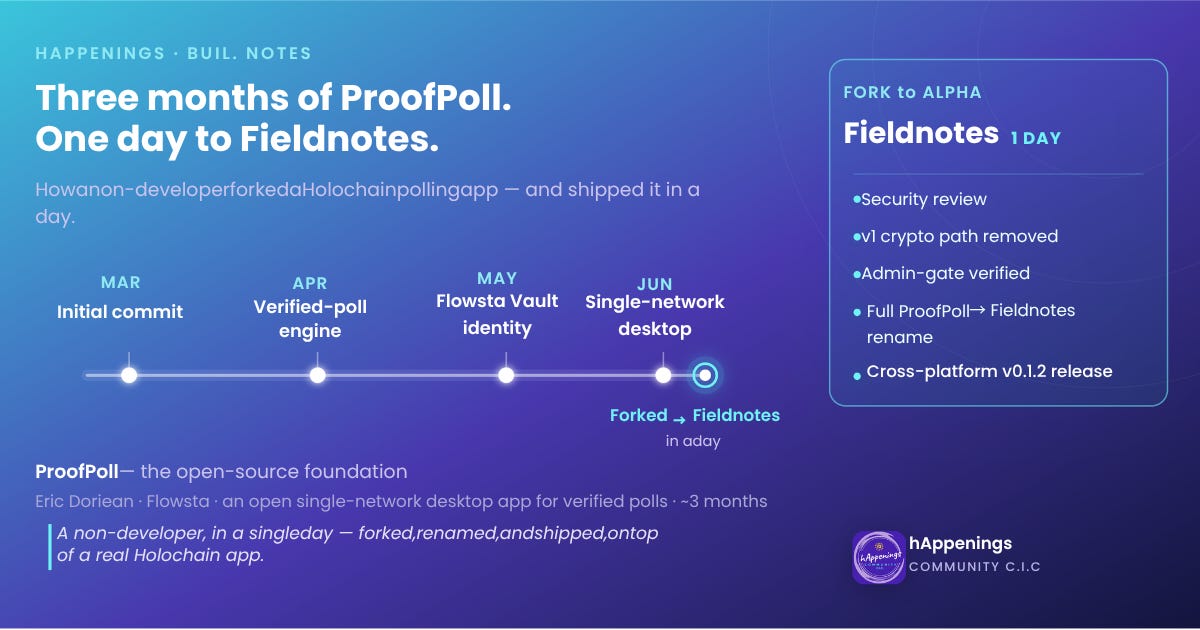
To see how much was already done, look at the project’s history. Software built with Git keeps a dated record of every change ever made to it, and because Fieldnotes grew out of ProofPoll, it carries that whole history with it. It opens on the first of March 2026: identity, encryption, the update system, release configurations, three months of work, all by other people. My addition is the shortest stretch at the very end.
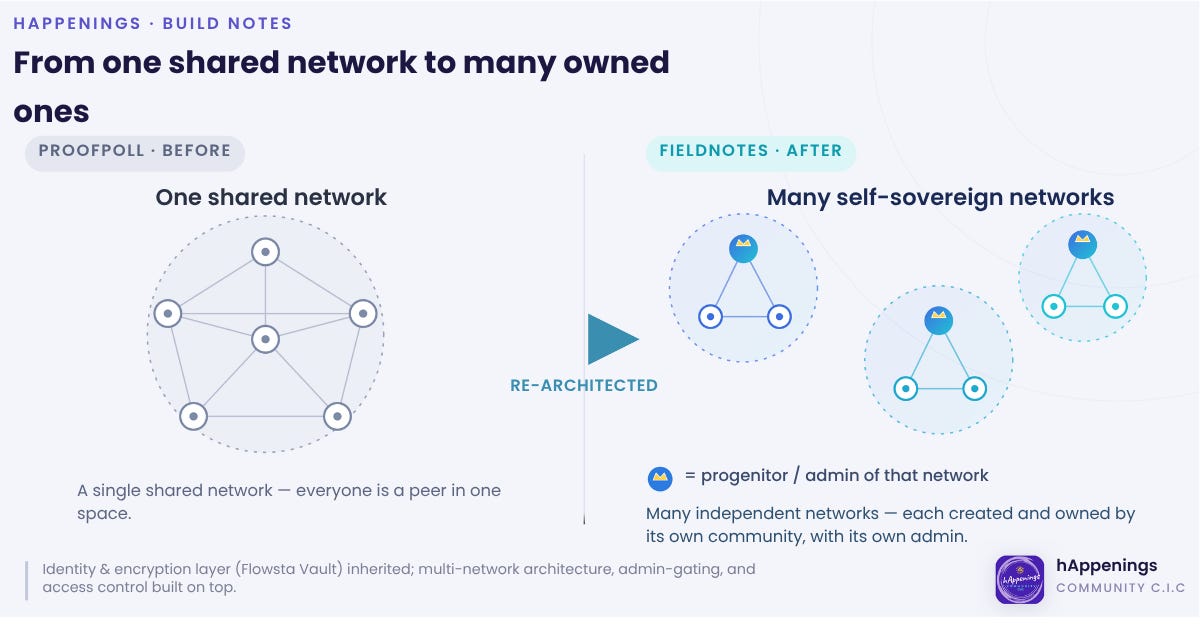
I didn’t touch the identity system: signing in, proving you’re the same person across two devices, keeping your keys safe. The fiddly business of running a Holochain application on a small server inside your own desktop, and keeping it alive through crashes, comes from Flowsta’s Vault. So does private note-keeping; so do the pipelines that publish the Mac app. What was left for me is small enough to say in a sentence: I changed what the app is about, from polls and votes to test scenarios and findings. I built a handful of things on top, because the core complexity was already taken care of.
One piece didn’t transfer: ProofPoll’s published versions carry Flowsta’s Apple-issued code-signing certificate. I inherited the app code, but not the certificate, so Fieldnotes ships unsigned. Mac is the only build released so far; if you run it, your Mac will warn you the first time you open it. Right-click the app in Finder, choose ‘Open’, and after that, it should behave normally. The full step-by-step is in the repository.
Proof Positive
I’ve been honest about what I inherited, and I’ll talk about the problems. First, I want to be precise about the part that gave me no friction at all.
Flowsta has built a full suite of tools for handling cryptographic identities on the decentralised web. When Fieldnotes needed an identity system, it leaned entirely on Flowsta’s, and so did I, as a user. I created an account for free, linked it to the app, and re-authorised through Flowsta’s login each time I rebuilt. It was, in the most ordinary and welcome sense, faultless.
That matters more than it sounds. Identity is foundational to distributed systems like Holochain, and one of the hardest things to make pleasant. Most peer-to-peer systems ask you to understand something technical before you can begin. Flowsta asked me to use things I already know: single sign-on, two-factor codes, and a password manager. The difficult cryptographic work doesn’t disappear; it moves somewhere I don’t need to think about, as either a user or a developer. Doing that quietly is what makes Flowsta’s work special.
Absolute Proof
Here is the thing nobody tells you about building this way. The AI is astonishingly good and, intermittently, confidently wrong, and the two are not always separable. It is the brilliant colleague who has read every book in the library and never once set foot in the lab. Ask it the general shape of a thing, and it’s usually right. Ask it the exact name of an unusual function, or the precise behaviour of a tool it has never actually run, and it will make things up with total conviction. More than once, it sent me down a path that didn’t exist, described as confidently as the paths that did.
You can’t always tell which kind of answer you’re getting. So the whole discipline comes down to one habit: never trust the claim, check the source. AI is wonderful at proposing solutions and unreliable at remembering exact context; let it reason from memory, and it will eventually, charmingly, walk you off a cliff. What checking looks like in practice is in the companion guide.
The clearest example is also the most important part of the whole app. Fieldnotes has a lock on it: only an authorised administrator should be able to add test scenarios or view screenshots, and that rule is meant to be enforced at the deepest level, not just hidden behind buttons. The AI and I built it as a variation of ProofPoll’s lock. It looked right; the app complied and the UI behaved exactly as I expected. It wasn’t actually locking. It was letting things through while silently failing. In an app demonstrating secure identity, that’s a problem.
What caught it was not a flash of insight. It was a test. I needed to check two people on the same network, one authorised and one not. I’m one person with one computer, so I can’t be two genuinely different peers without a test harness. I couldn’t have written it myself, so I asked for it. Fieldnotes failed the test: the unauthorised person was getting in. I traced it down, fixed it, and ran the test again. This time, the unauthorised peer was refused, and even an attempt to slip through by faking someone else’s permission was prevented. The lock held, and now there’s proof it held. That check is what stands between “it looks like it works” and “it works”; between those two is exactly where confident, untested answers live.
The tool that caught it is Holochain’s sweettest, runs checks across several simulated peers. The lesson is simple: run tests as you build, and before you share. You don’t have to write them by hand, but you do have to know to ask. The companion shows how, without a word of code.
Mutual Proof
“A non-developer built a hApp in a day” hides more than it tells. Others did the heavy lifting, and there were a few things I leaned on.
Holochain Agent Skill, written by Sacha Pignot, lead developer at hAppenings Community, taught the AI how Holochain actually works before we began: its architecture, its validation rules, and how to test it across peers. It reasoned like something fluent in this world rather than guessing from general web habits, and when it later knew to reach for the right kind of test, that was Sacha’s groundwork showing.
Claude Opus 4.8 brought speed, recall, and the ability to read code faster than any person, alongside its real and constant liability.
And I brought two things only a person could: judgment about where a peer-to-peer system stops behaving like the software my instincts expect, and the discipline to make the AI prove every claim against the source.
Every item on that list is freely available, and that’s the point. I took the time to think in a particular way, starting from privacy and resilience rather than bolting them on, treating people’s data as theirs to keep. That’s the whole of it, and it’s a smaller thing to ask of someone than “become a programmer first.”
To read the rest of the article, and discover the useful links, click the button!
🌟 Latest News from hAppenings.community
If you’re new to “What’s hAppening” and the hAppenings Community, WELCOME! We invite you to explore our website, hAppenings.community, our Holochain Project Database (searchable), and we would love if you would join our Discord Server!
Also, if you’ve you’d like to see a type of retrospective of Holochain projects, check out the back issues of this newsletter. It’s rather amazing! And we always appreciate new and paid subscribers (who help keep the lights on!) Thanks, Anita Halcyon & Sam Turner!
🌟 Latest Official News and Events from Holochain, Holo & Unyt
Blog: DevPulse 154, by Paul D’Aoust
"Smooth like butter." That's the verdict on the newly released Holochain 0.6.1. 🧈
We've just published Dev Pulse 154, detailing the massive engineering effort behind this release. By integrating the Iroh networking layer into our active 0.6 branch, we've delivered a new baseline for peer-to-peer reliability. Connection drops are minimized, peer discovery is faster, and the network recovers gracefully from chaos.
If you are building agent-centric distributed apps, this is the architecture you want to be building on. Dive into the technical details (and the breaking changes from 0.6.0) in the latest Dev Pulse.
Ecosystem News: Iroh 1.0 Announcements
Huge congratulations to the Iroh team! They just officially released Iroh 1.0. For the builders here, you already know that Iroh is the new networking engine powering Holochain 0.6.1. Their approach to QUIC multipath, hole-punching, and local-first discovery is a huge reason why the recent HOT-HF technical migration test ran so smoothly. If you are interested in the lower-level networking tech that makes Holochain tick, we highly recommend reading their 1.0 announcement blog: https://www.iroh.computer/blog/v1 We also encourage you to drop into their community at their Iroh Discord: https://discord.com/invite/DpmJgtU7cW
Are you a Developer? Join Holochain.org’s Developer Portal: https://developer.holochain.org/
For a complete listing of all of the Holo Ltd and Holochain Foundation events go to their ‘Upcoming Events’ page!
🌟Latest News from the Holochain Ecosystem:
Conference Update: Superintelligence for Humanity, by Matthew Schutte
This research summit on artificial intelligence was full of brilliant insights. I particularly enjoyed some of the comments from Ahmer Inam, Blaise Agüera y Arcas, Pierre-Yves Oudeyer, Divya Chander, Michael Levin, Olaf Witkowski, Damián Blasi and a longtime favorite, Bruce Schneier.
Note: Watch the full inaugural event recording!
🌟Other Related News & Events

Announcement: Emerging Voices in AI & Society Fellows Program from the Center for Humane Technology
Center for Humane Technology is pleased to announce we’re opening applications for our inaugural Emerging Voices in AI & Society Fellows Program.
The cohort will research and help shape public discourse across multiple potential areas, including: AI and Cognition, AI and Relationships, AI and Surveillance, AI and Spirituality, and Inside the Machine: a technologist's view of what drives decisions at leading AI companies.
Applications are open through July 12, 2026. The cohort begins September 14.
If you've been thinking about how AI is reshaping human life and you have something to say that is missing from the current conversation, we'd love to hear from you.
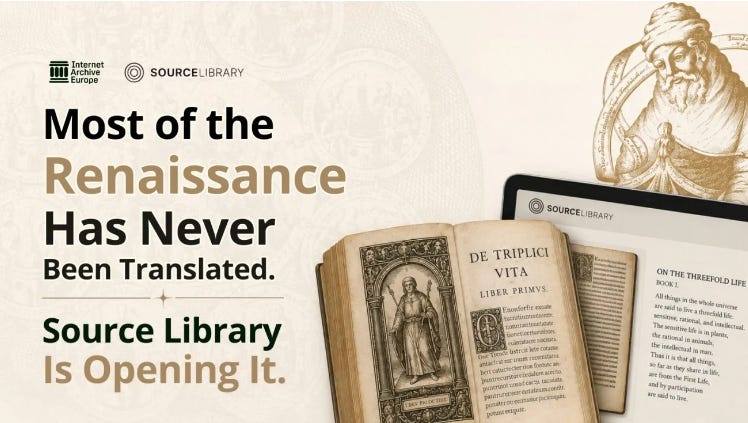
Article: Most of the Renaissance Has Never Been Translated. Source Library Is Opening It. from the Internet Archive EU
Most of the Renaissance has never been translated.
Around 90% of Renaissance Latin has never been translated into a modern language. More Latin was written after 1500 than survives from all of ancient Rome, yet much of it remains accessible only to specialists.
Last week, Internet Archive Europe attended the launch of Source Library at Amsterdam's Embassy of the Free Mind.
With more than 15,000 historical works, 55 languages, and 6,000 first-ever English translations, Source Library is opening a vast body of knowledge that has long been out of reach for most readers.
The project raises a question we encounter often: who gets access to knowledge, and on what terms?
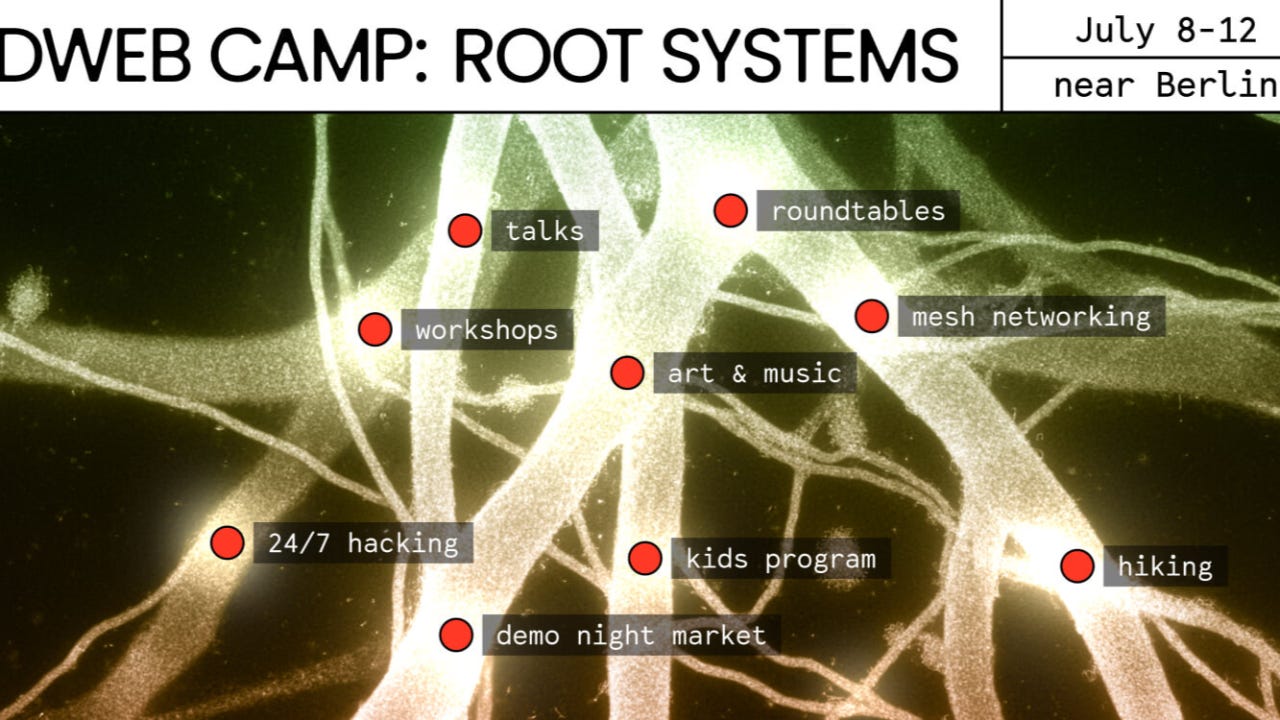
Event: DWeb Camp 2026: Root Systems, July 8-12, 2026 in Alte Hölle, Germany by DWeb
DWeb Camp 2026: Root Systems is a five-day gathering in nature for builders and dreamers dedicated to building a decentralized web (DWeb). A web that is private, resilient, and beyond the control of a few central powers. Like forests, decentralized systems derive strength from what lies beneath the surface: dense networks of roots, sharing resources without hierarchy, and coordination that persists even when individual nodes disappear.
DWeb Camp: Root Systems invites participants to build technologies that–like living ecosystems–adapt, regenerate, and endure.
Note: Here’s another link to DWeb Camp 2026!

Announcement: Dweb Camp Cascadia 2026 call for proposals!
We just announced our theme Co-Adapt, Co-Create, Co-Here. Now we invite you to join us in co-creating DWeb Camp Cascadia, happening from July 30th to August 3rd 2026. If you have an idea for a talk, workshop or any other activity, let us know, we are looking forward to hearing about it!
Do You Have News & Updates?
If you are a team member of a Holochain Project and would like to share your latest news and updates, please…
If you have a question, request, or simply a desire to connect more about hAppenings.community please click the link above!