
Moss: Gathering Without The Cloud

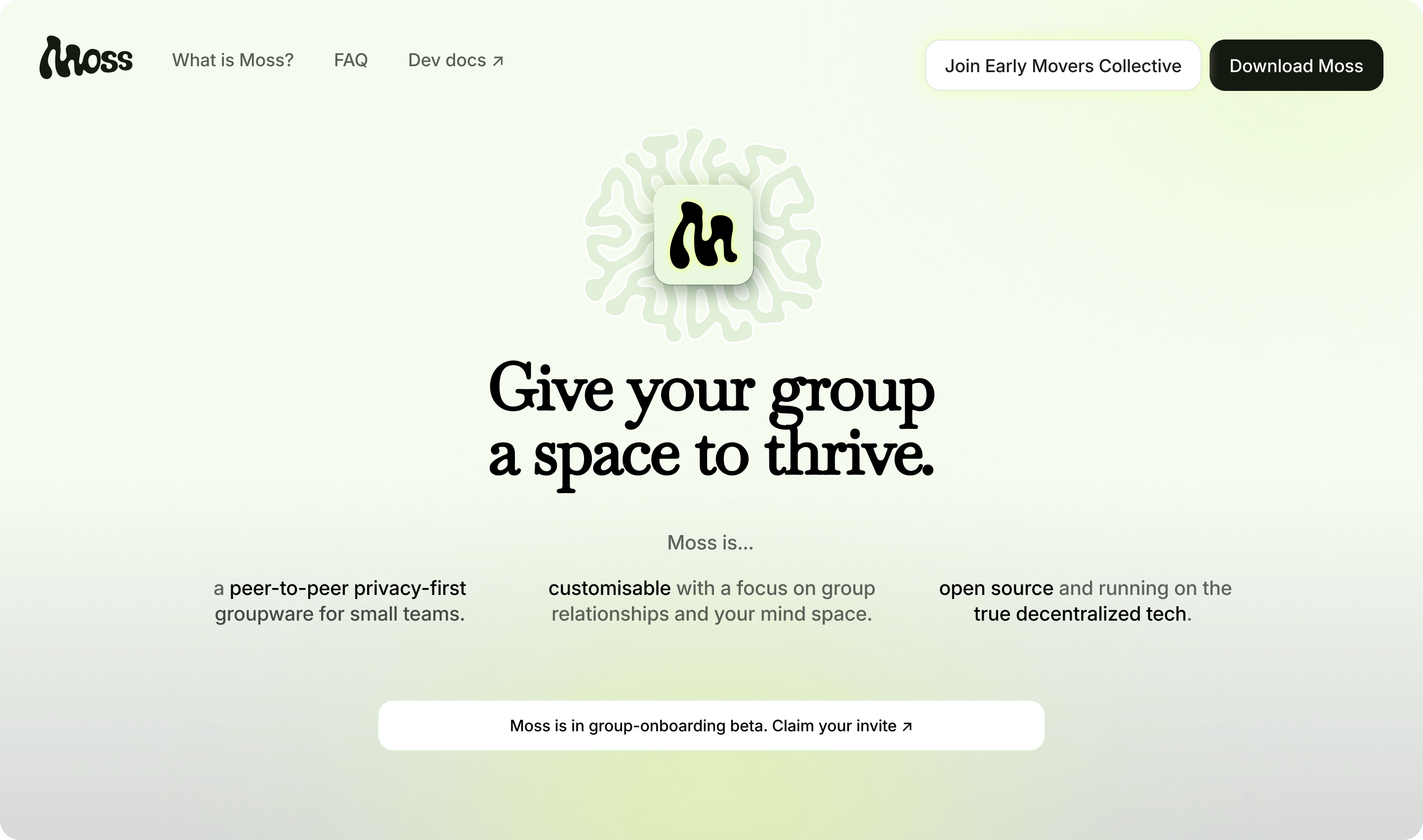
If you want to experience Holochain’s peer-to-peer framework today, the most capable application currently available is Moss. But Moss isn’t just an app, it’s a workspace platform with a library of tools you can mix and match: chat, video calls, collaborative documents, spreadsheets, kanban boards, and accounting tools.
Think of it as an alternative to Google Workspace or Microsoft Teams with a fundamental difference: your team’s data stays on your team’s computers. When you create a shared document in Google Docs, your text travels to Google’s servers, gets stored in their data centres, and comes back to your screen. Everyone in your team sees the same words because Google’s computers are the single source of truth. Simple, reliable, and entirely dependent on them, as a third-party, to maintain access to your team’s business-critical data.
Gathering Moss Together
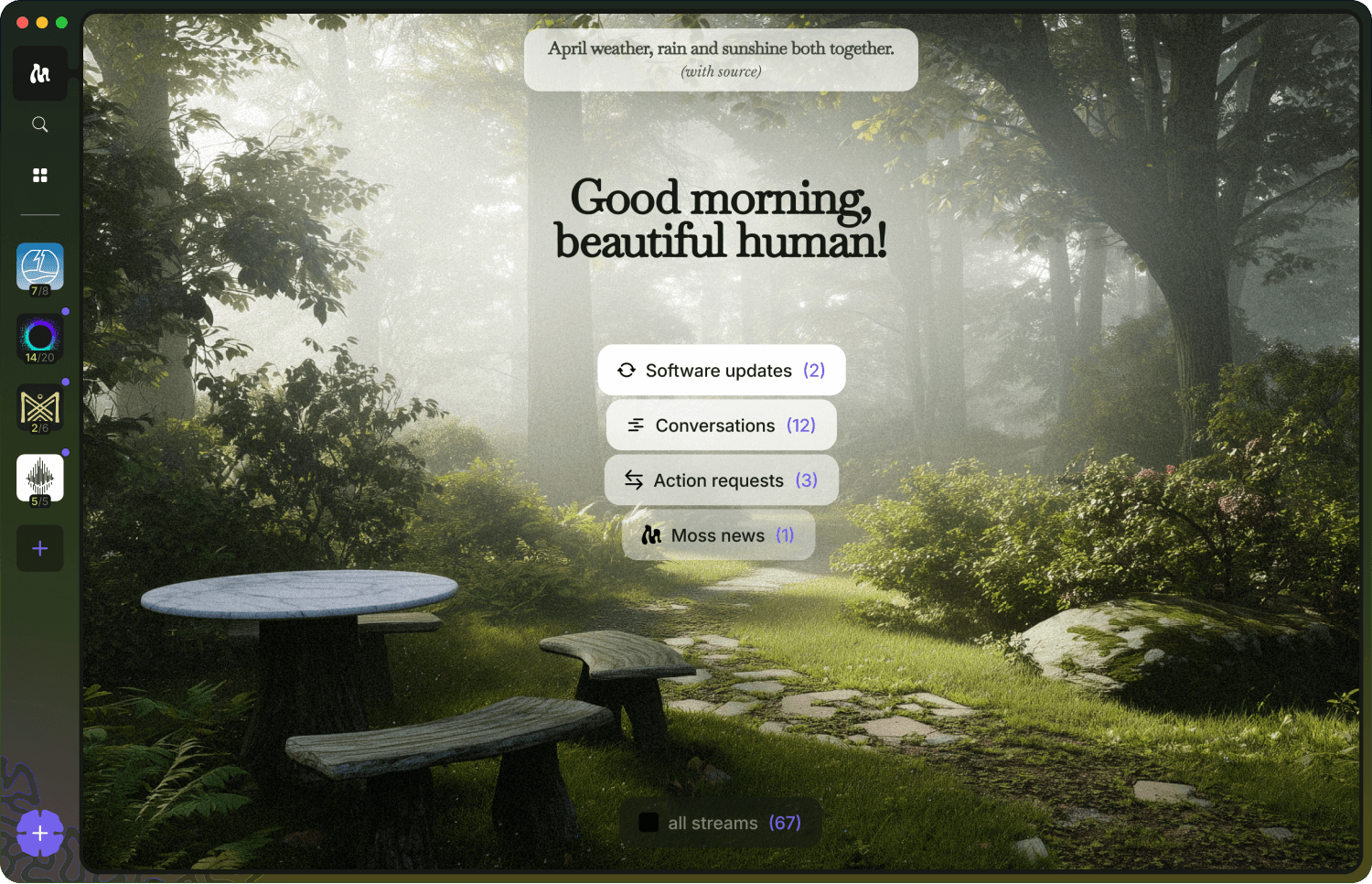
Moss is different. Built by Lightningrod Labs (founded by Holochain co-creator Eric Harris-Braun), Moss is a collaborative workspace where your group’s data lives on your group’s computers, not on corporate servers. When you edit a shared document or move a card on a kanban board, that change syncs directly between you and your teammates using Holochain’s peer-to-peer network.
When you use Google Workspace, your documents and emails increasingly feed AI systems you didn’t ask for. Opt-outs are buried across multiple menus. LinkedIn quietly enrolled users in AI data sharing without notification until public outcry forced a reversal. Microsoft Copilot has exposed millions of sensitive records. The pattern is clear: Big Tech treats your data as training material first, asks permission later (if at all).
Monolithic Weight
But privacy is only half the problem. The other is access. Large enterprises run private networks precisely because they can’t afford to depend on third parties for business-critical data. Startups and small organisations don’t have that option. They’re locked into SaaS platforms for documents, project management, CRM, and communication. When those services change pricing, alter terms, get acquired, or shut down, smaller teams absorb the risk. Your data is held on someone else’s servers, accessible at their discretion.
Moss offers an alternative: there’s no advertising pipeline, no AI training on your content, no company in the middle analysing your collaboration patterns. You’re not a user paying to access a Big Tech platform. You’re running free and open-source software, holding your own data and cryptographically signing every action you take.

Rolling Together
Like all Holochain applications (hApps), Moss uses cryptography to manage permissions between users and groups. The flexibility provided by Holochain’s agent-centric design is the foundation upon which Moss is grounded. Eric Harris-Braun highlighted:
“Moss unites many DHTs (distributed hash tables), some for greeting the group boundary (managing profiles, membership and the tools used), and others for the tools themselves. One way to look at Moss is as an ‘opinionated Holochain runtime’ that uses Holochain to create this weaving of ‘groups’ and ‘what-we-do-in-our groups’ together.”
Moss acts as the software ‘container’ in which groups gather, determine their culture and purpose, embedding it in their DNA. Using it to manage group integrity and permissions to the tools those groups use, and coordinate data they create with them. Moss utilises Holochain’s Conductor to gossip between users maintaining coherence while also benefitting from the inherent resilience of Holochain’s architecture. The result: shared truth without a central authority.
Moss also uses The Weave, an open standard developed by Lightningrod Labs for how Holochain tools work together. The key innovation is the Weave Asset Locator (WAL): a unique address for any asset created in Moss, whether that’s a document, a kanban card, or a video call. WAL supports asset sharing across different tools within groups. Working on a Notebook doc and want to discuss it on a video call? Copy the WAL, paste it into Presence, and everyone can see it. This interoperability happens entirely peer-to-peer, with no central server coordinating the handoff. Read more details about The Weave in our previous article.
Moving the Monolith
Moss currently offers 16 tools, with more on the way. Rather than one monolithic application trying to do everything, you pick what your group needs.
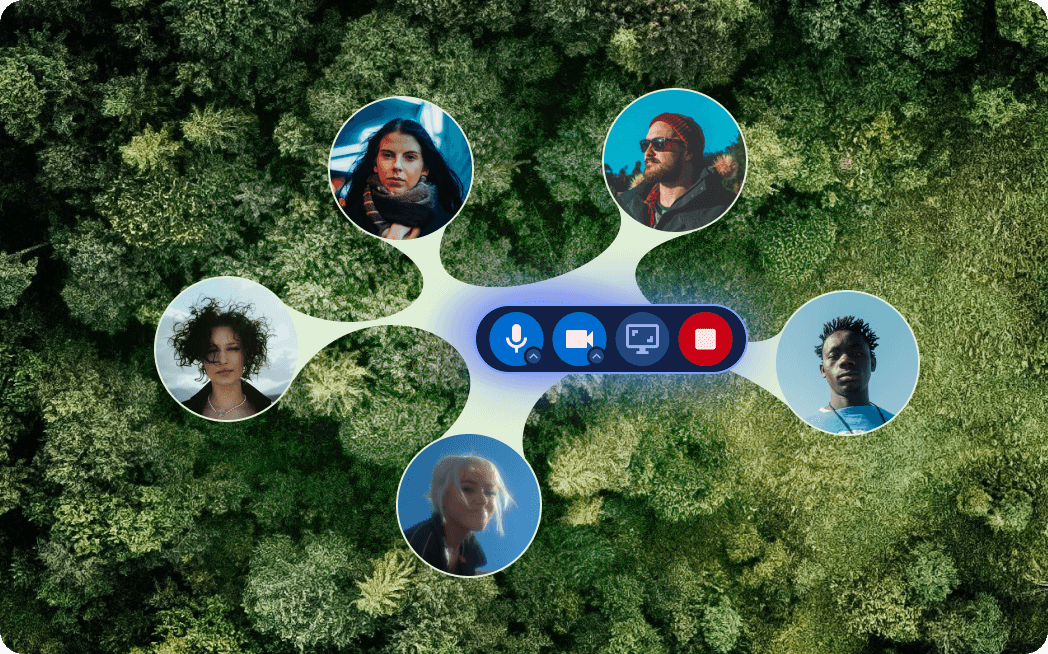
For everyday communication, there’s Vines for group chat and Presence for peer-to-peer video calls with screen sharing. Document work is covered by Notebooks (collaborative markdown with version control), Spreadsheets, and Files for storage. If your team thinks visually, Slate provides a shared whiteboard while TalkingStickies handles brainstorming sessions and retrospectives.
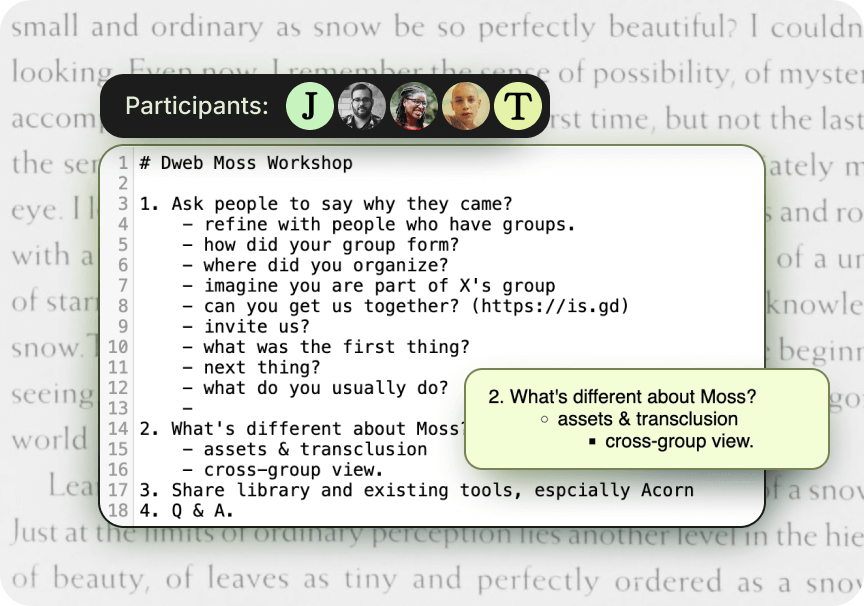
Project management has several options depending on your style. KanDo offers kanban boards with commenting, labels, and checklists. Acorn provides full agile project planning for distributed teams. Who’s In? handles event planning, task
management, and agreement tracking. For conferences and larger gatherings, Emergence manages session scheduling, space allocation, and collaborative notes.
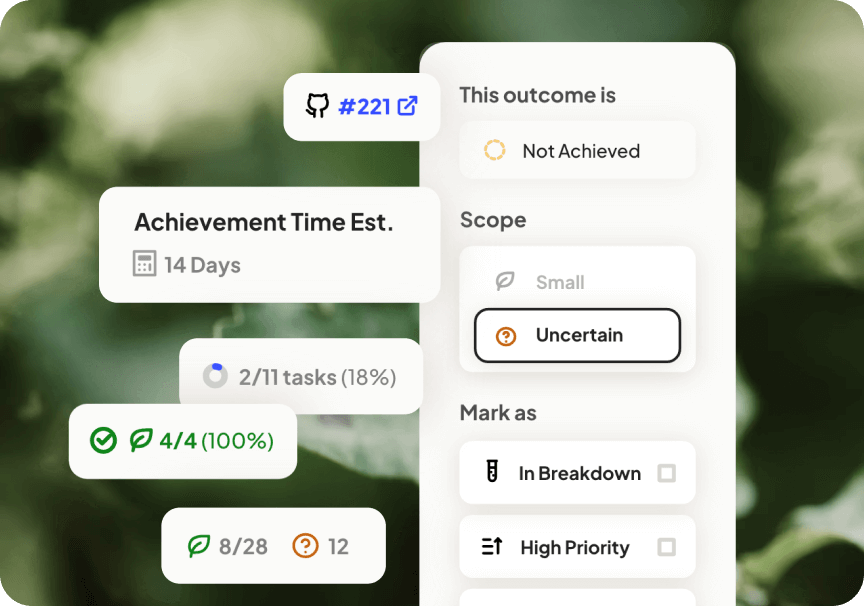
Converge supports group decision-making by shifting focus away from debating outcomes to agreeing on criteria first, drawing on convergent facilitation and nonviolent communication.
There’s even Gamez for creating and playing tabletop games together. Not everything has to be serious!
Big Tech’s answer is to integrate more of their own tools, in their closed ecosystems, using th n accross hApps. As one of the co-founders of Holochain, Eric had more to share about the open, interoperable,integration Moss supports:
“It’s important to say it’s a totally open ecosystem. Anybody can build and add the specific tool they want for their context. They will automatically work with other tools, no “integration” costs. That’s part of what comes with the framework starting with integration at the base layer, not something that’s added on top, which is what is the case in the web world. Integration is a value add that you have to pay for across Web silos. In the Weave, integration is native.”
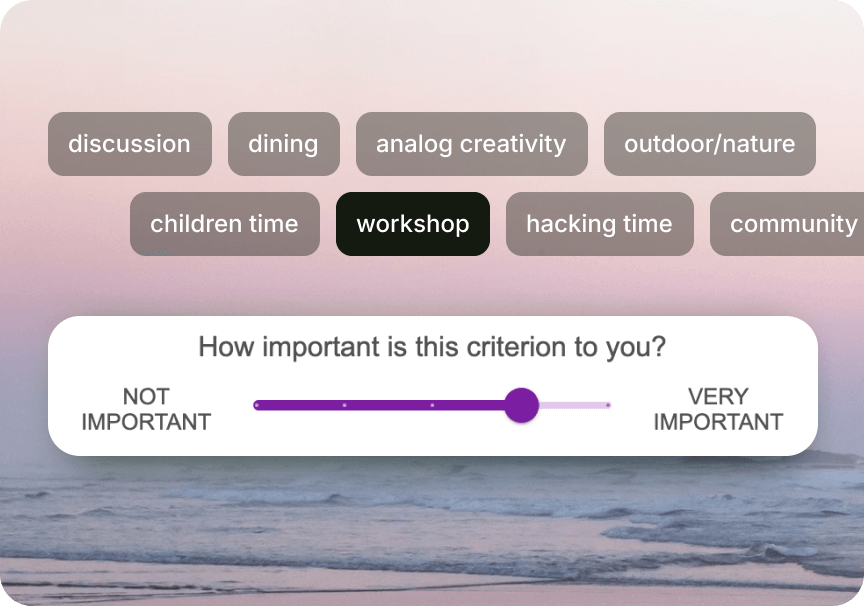
The tool library started with Lightningrod Labs building essential apps. Third-party tool publishers are emerging too: Presence is built by Matthias Meier, and the recently released Unyt applet provides accounting and smart agreement functionality.
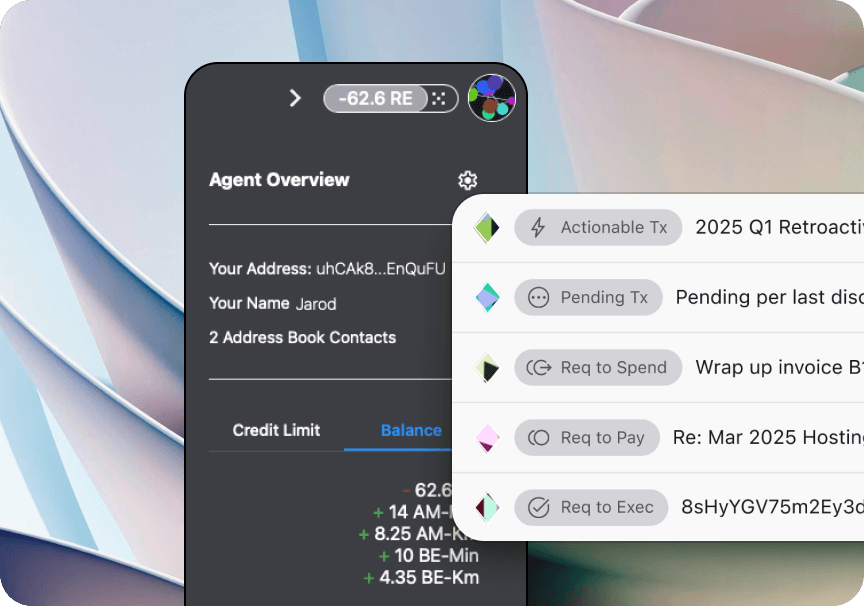
The cohesive organic feel that Moss provides, as a container for these diverse tools, is the work of Iryna Nezhynska at Lightningrod Labs. She also kindly provided the graphics that illustrate this article.
Where Moss Grows
Market dominance, disguised as convenience and interoperability, has led to dependency on Big Tech. And, let’s be honest, the mainstream tools work fine; they are useful exactly because they’re ubiquitous. Moss isn’t trying to replace Google Workspace or Microsoft. But there is a large, legitimate and growing market for use cases Big Tech can’t meet:
Privacy-first organisations. Journalists protecting sources, legal teams handling sensitive cases, healthcare practitioners discussing patients, activists coordinating in hostile environments. When your work depends on confidentiality, storing conversations on corporate servers is a liability.
Third sector and values-aligned organisations. Charities, co-operatives, mutual aid networks, and community trusts and foundations often find commercial platforms philosophically uncomfortable. Why feed sensitive data to extractive systems while organising alternatives to harm? Moss lets groups practise the sovereignty they preach.
Distributed teams that want resilience. Organisations that cross multiple time zones or have unreliable internet connections can benefit from Moss’s Edge Node network, which supports offline work. Solving the long-standing issue of asynchronous coherence in p2p networks, using Edge Nodes, Moss allows work to continue locally, syncing changes when connections allow. For disruptive tech-led startups, this is a game-changer.
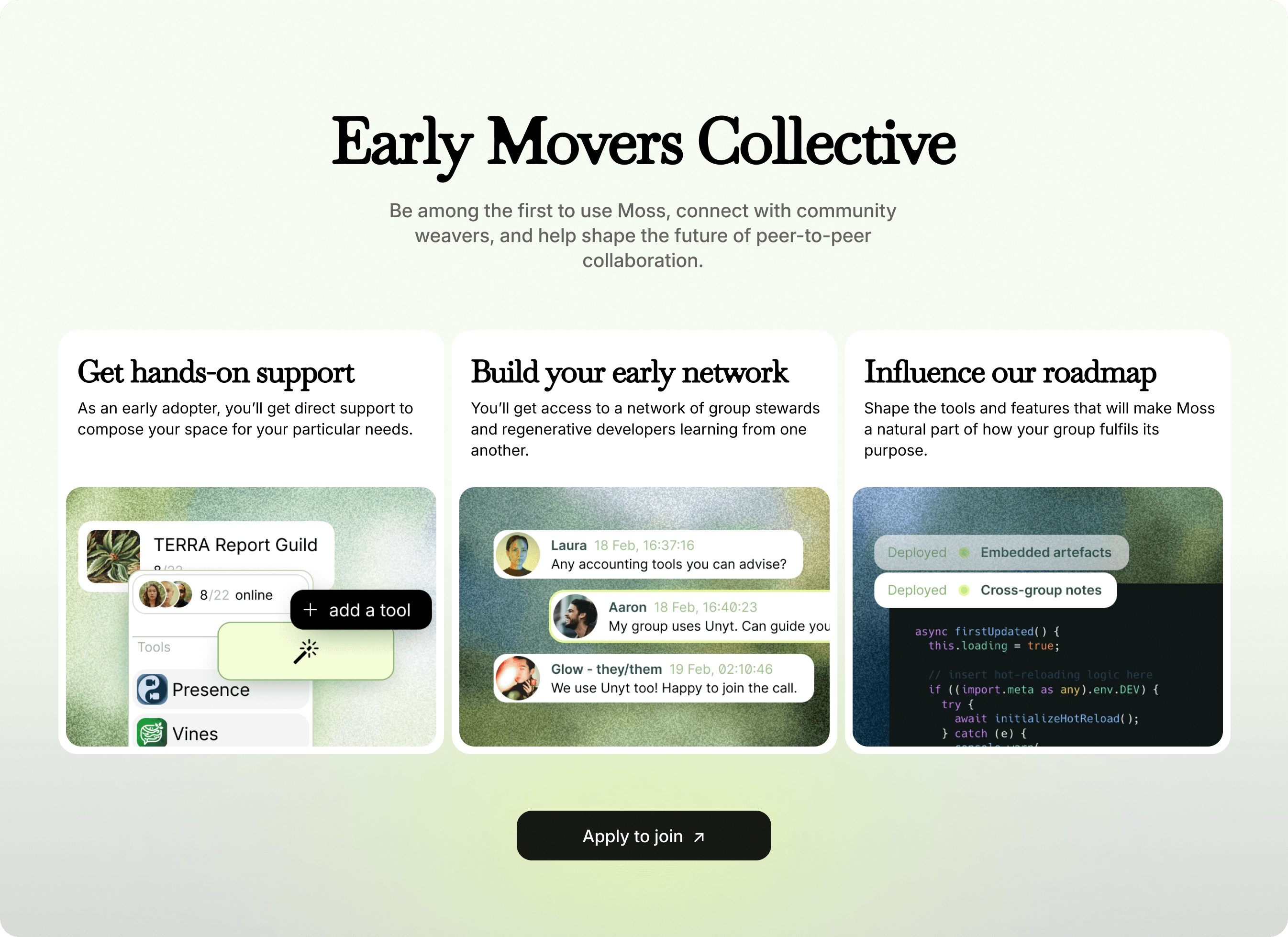
Join the Early Movers Collective
Moss is available to download and use now. You can create a group, explore the tool library and invite people to join your group.
If you’d like to join the Early Mover’s Collective Test Group on Moss, apply below:
You can also get deeper into the Holochain infrastructure by running an Edge Node on your Holoport or computer. Providing an “always-on” relay for the Holochain group, or your own groups, you can read more about them and find links to the deployment instructions in our previous article.
Current Big Tech players want us to keep rolling their monolith. Moss offers us somewhere to settle and be more thoughtful about our choices. The tools are ready. The groups are gathering. If you want to experience Holochain’s peer-to-peer framework today, Moss is where to start.
Useful Links
🌟 Latest News from hAppenings.community
If you’re new to “What’s hAppening” and the hAppenings Community, WELCOME! We invite you to explore our website, hAppenings.community, our Holochain Project Database (searchable), and we would love if you would join our Discord Server!
Also, if you’ve you’d like to see a type of retrospective of Holochain projects, check out the back issues of this newsletter. It’s rather amazing! And we always appreciate new and paid subscribers (who help keep the lights on!) Thanks, Anita Halcyon & Sam Turner!
🌟 Latest Official News and Events from Holochain, Holo & Unyt
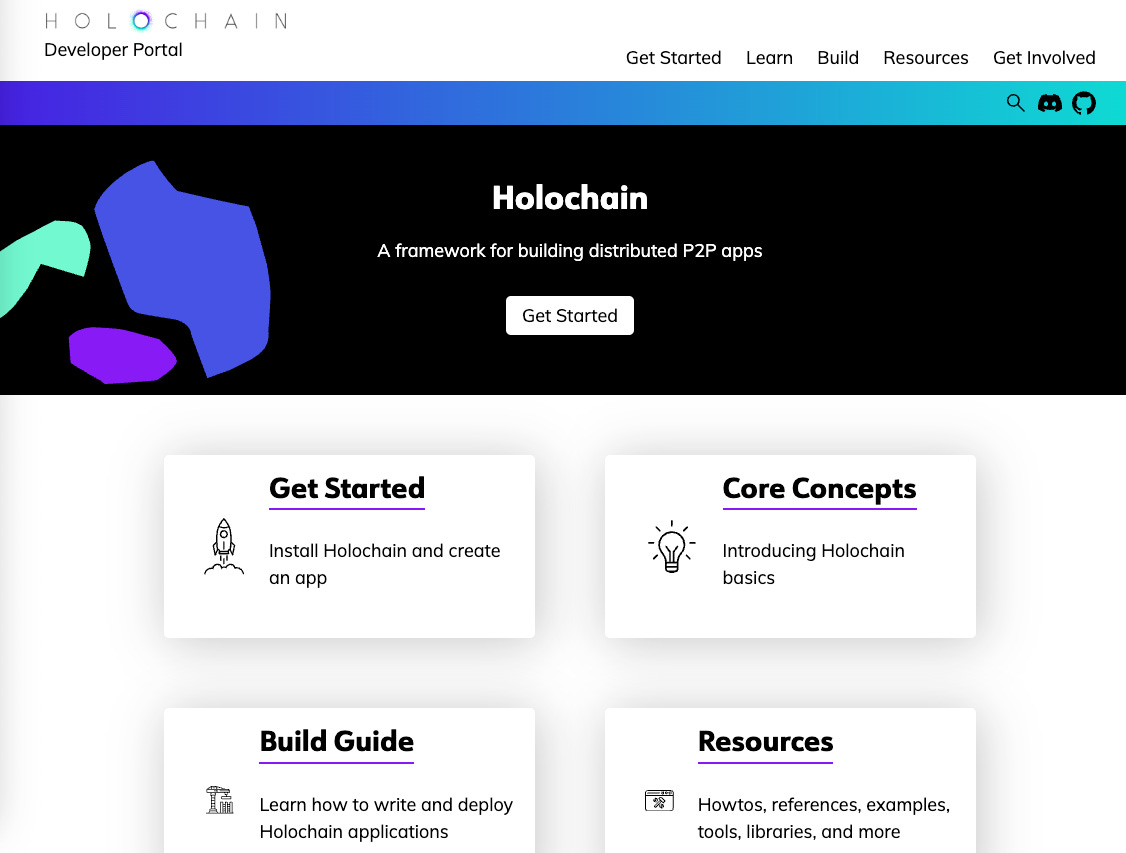
Announcement from the Holochain Foundation - Upgraded Developer Portal
Honest talk: A year ago, our docs were often too conceptual. Great for theory, but tough for actually building
The new Holochain Build Guide fixes that. It shows you how to actually use every single function and tool. Less philosophy, more practical application. If you bounced off the docs before, take another look.
Blog: Beyond Trading Pairs - Atomic Multi-Currency Trades from Unyt
What if you could pay with whatever you have?
We just shipped atomic multi-currency trades in Unyt. Two parties can now swap bundles of different units—directly, peer-to-peer—without exchanges, order books, or liquidity pools.
Why does this matter? Because we keep forcing value through artificial bottlenecks. You have capacity to offer, someone wants it, but you’re stuck navigating trading pairs and gas fees just to get the “right” currency.
In Unyt, conversion rates derive from actual economic activity—what units purchased yesterday—not speculation. Agree on the trade, and it either completes entirely or reverts entirely. No intermediate states, no stranded funds.
One small example of how we’re rethinking what crypto transactions can be.
Video Guide: Holo How To Series: Holochain Wind Tunnel Testing using Holo Edge Node on Fedora Virtual Machine
Why are we intentionally trying to break our own network?
In distributed systems engineering, “happy path” testing isn’t enough. You need to simulate chaos.
That is the purpose of Wind Tunnel, a collaborative stress-test between the Holochain team and the Holo Hosting community.
We are asking users to spin up Edge Nodes specifically to generate high-velocity traffic. The more nodes that join, the higher the resolution of our performance data.
Want to help us harden the next generation of the web?
Join Holochain.org’s Developer Portal: https://developer.holochain.org/
For a complete listing of all of the Holo Ltd and Holochain Foundation events go to their ‘Upcoming Events’ page!
🌟Latest News from the Holochain Ecosystem:
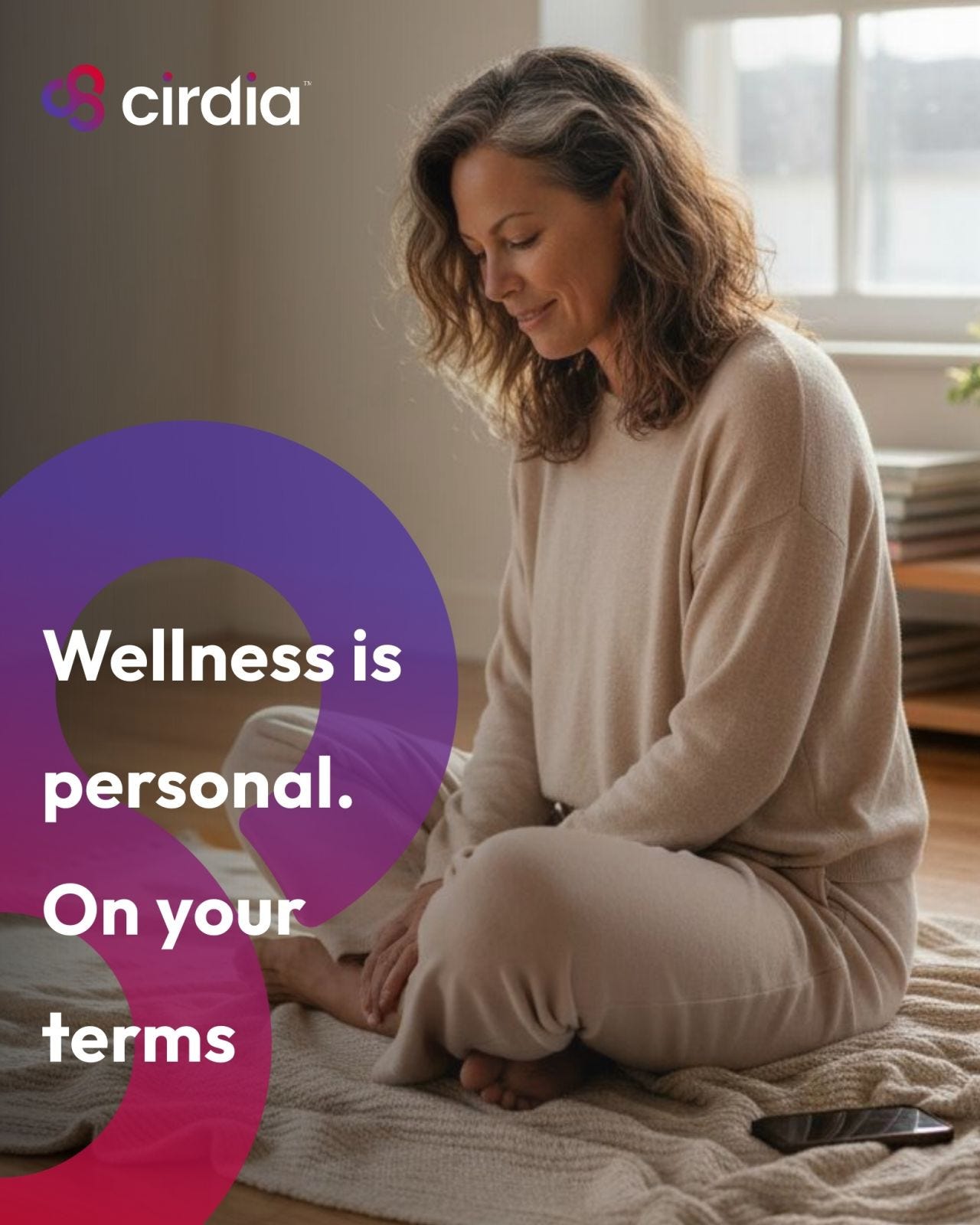
Update: ChatGPT Health Announcement shared by Cirdia
This week’s ChatGPT Health announcement sparked an important public conversation about trust in health tech.
Not about whether AI belongs in healthcare, but about something more personal: who controls intimate body data over decades of use.
At Cirdia, this question is foundational. We’re building privacy-first wellness technology designed so intimate body data stays under the user’s control by design, not by policy. Especially in midlife wellness, trust isn’t built through features. It’s built through architecture.
This is what wellness on your terms looks like when health technology is designed for long-term relationships, not data extraction.

Announcement From Robin Haug of Volla Systeme GmbH (Note: The Holochain Foundation has a partnership with Volla )
Opensource OS app compatibility is CRUCIAL for #EuropeanTechSovereignty. Well, for the entire world. Volla Systeme GmbH launches #UnifiedAttestation Kickoff in February*.
*I have mentioned January in earlier posts. But things are moving really fast now and even huge companies now seem willing to enter the contributor group, thus some delays to make space. All will be opensourced and with MIT or Apache license.
No, this is not an issue only for OS manufacturers. It’s crucial for all makers of whatever opensource tech. And all users. All of us. A great E2EE, for instance, means practically nothing if run on Windows, iOS, macOS or GoogleAndroid. Let’s say you have created a Signal group for confidential online comms. If only one of the members run on Windows/macOS or i-pad/OS/GoogleAndroid, the entire chain is always already compromised. It’s time to understand the seriousness of this.
Now, with app compatibility, which plays such a huge role in our lives, for all safe and secure OSes, we will see a huge market uptake of all kinds of opensource tech. The dominant positions of companies like Microsoft, Apple and Google is based upon ridiculously systemically skewed conditions. With opensource app compatibility, including mobile Linux and others such of course like OniroOS and OpenHarmonyOS, we will see fair and free competition, heightened security, and also the genuine interest among the public in these disgusting #spyware technologies: which is actually LOW. These players can only enjoy “success” and “market dominance” by deception and cheating.
New App Launched: Flowsta is Live!!
Like Login with Google, but completely private.
Flowsta Auth is the first commercially available Holochain-powered app on the market.
Create and manage your account at https://flowsta.com
🌟Other Related News & Events
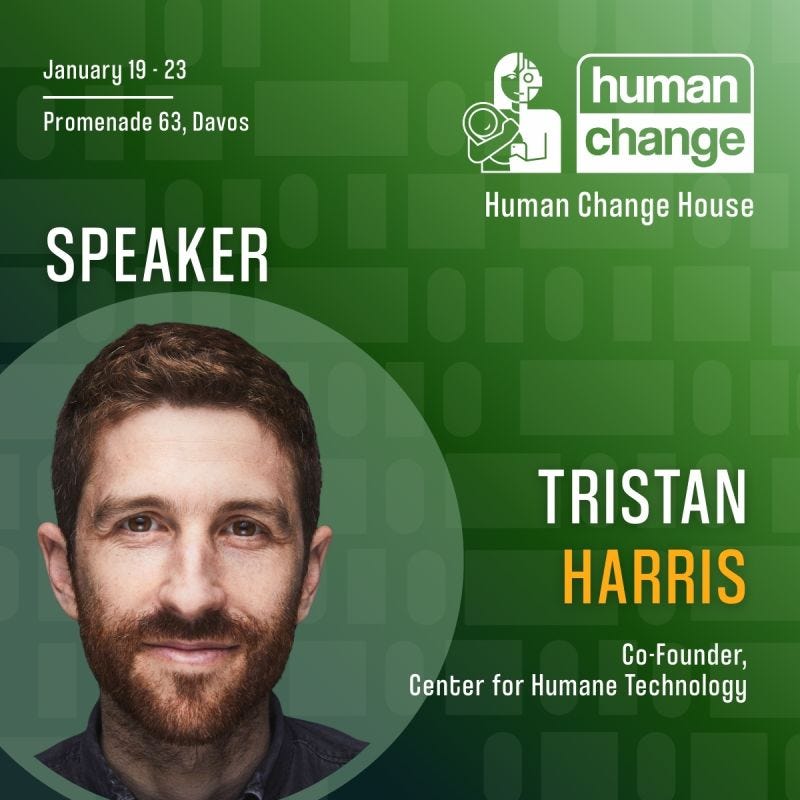
Event: Panel at Davos with Tristan Harris at the Human Change House - Jan 19-23, 2026
CHT co-founder Tristan Harris and Executive Director Daniel Barcay are heading to Davos, Switzerland for the World Economic Forum's annual meeting. They’ll be joining several critical conversations at the at the Human Change house about the future we want our children to inherit.
Tristan and Daniel will be joined by thought leaders like Jonathan Haidt, Mitch Prinstein, Renée Cummings, Zak Stein, Rebecca Winthrop, and Gaia Bernstein to explore how we can better align technological progress with human wellbeing — starting with our children.
The recording of these panels will be available on YouTube at the conclusion of the conference.
You can learn more about the program here: davos2026.humanchange.com
Article: To Be, or Not To Be: Why Coordination Must Return to Life by Pete Corke
The polycrisis we’re living through isn’t a collection of separate failures. It’s what happens when our systems of coordination lose contact with what they were meant to serve: life itself.
At root, every civilisation answers one question, whether it realises it or not:
Are our systems oriented toward being, or toward not-being?
For decades, we built coordination around centralisation: abstract identities, abstract money, abstract value. Nature became a “resource.” People became users, labour, taxpayers. Value became something extracted from the future rather than sustained in the present. These systems worked—briefly—because they scaled control faster than understanding. But complexity has now outrun the centre’s ability to see, decide, and adapt.
This is not a moral failure. It’s a structural one.
Living systems don’t coordinate from the centre. They coordinate at the edges—through relationships, feedback, and continual rebalancing. Health is not imposed; it emerges when interactions are aligned with life.
Civilisation has reached a scale where it must obey the same rule.
That means identity must stop being something issued by institutions that never witnessed our birth or our lives. A living being’s identity is not a document; it’s continuity, participation, relationship—a pulse over time.
It means money must stop being a mechanism for extracting from the future and return to being a tool for coordinating care in the present. When incentives are aligned with living systems, regeneration stops being an ideal and becomes the most rational economic choice.
And it means we must rediscover ourselves as living nature, not managers standing apart from it—because you cannot hold nature as a living asset while believing you are separate from it.
This is where new peer-to-peer technologies matter. Not because technology saves us, but because—finally—it can get out of the way. It can allow coordination to emerge from people, communities, and bioregions rather than being imposed from above.
A final note: this piece was written in collaboration with AI. Many are asking whether AI will be good or bad for humanity and the planet. The answer is simple: no technology is inherently either. Technology only amplifies the value system it sits upon. When employed in service to life, it can help us remember how to coordinate accordingly. Plus I have too many words and the GPT helps me fit into character limits!
The question has always been the same:
To be—or not to be.
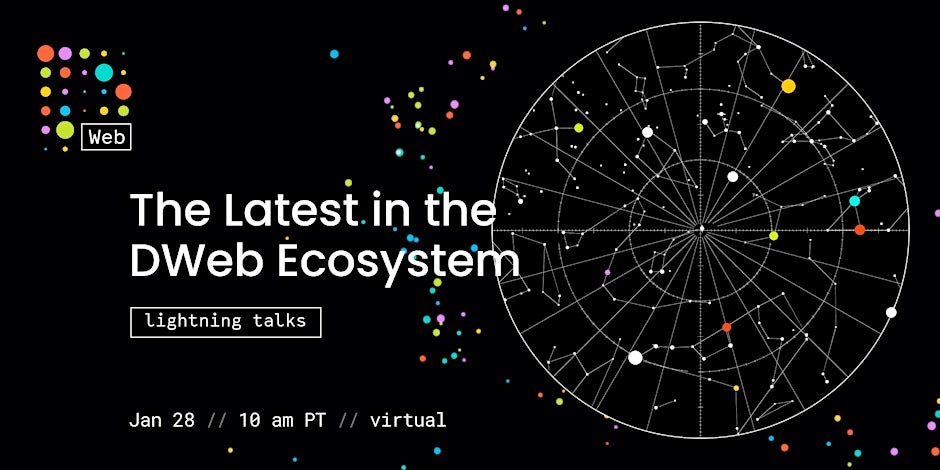
Virtual Meetup: January 2026 DWeb Virtual Meetup - The Latest in the DWeb Ecosystem
2026 is going to be a big year for us as we move the global DWeb Camp outside of the U.S. for the first time. We’re going to kick-off our first DWeb Virtual Meetup of the year featuring talks about two recent product releases, as well as a talk by a Berlin-based group that’s closely partnering with us to help bring you DWeb Camp in Germany this coming summer
Do You Have News & Updates?
If you are a team member of a Holochain Project and would like to share your latest news and updates, please…
If you have a question, request, or simply a desire to connect more about hAppenings.community please click the link above!